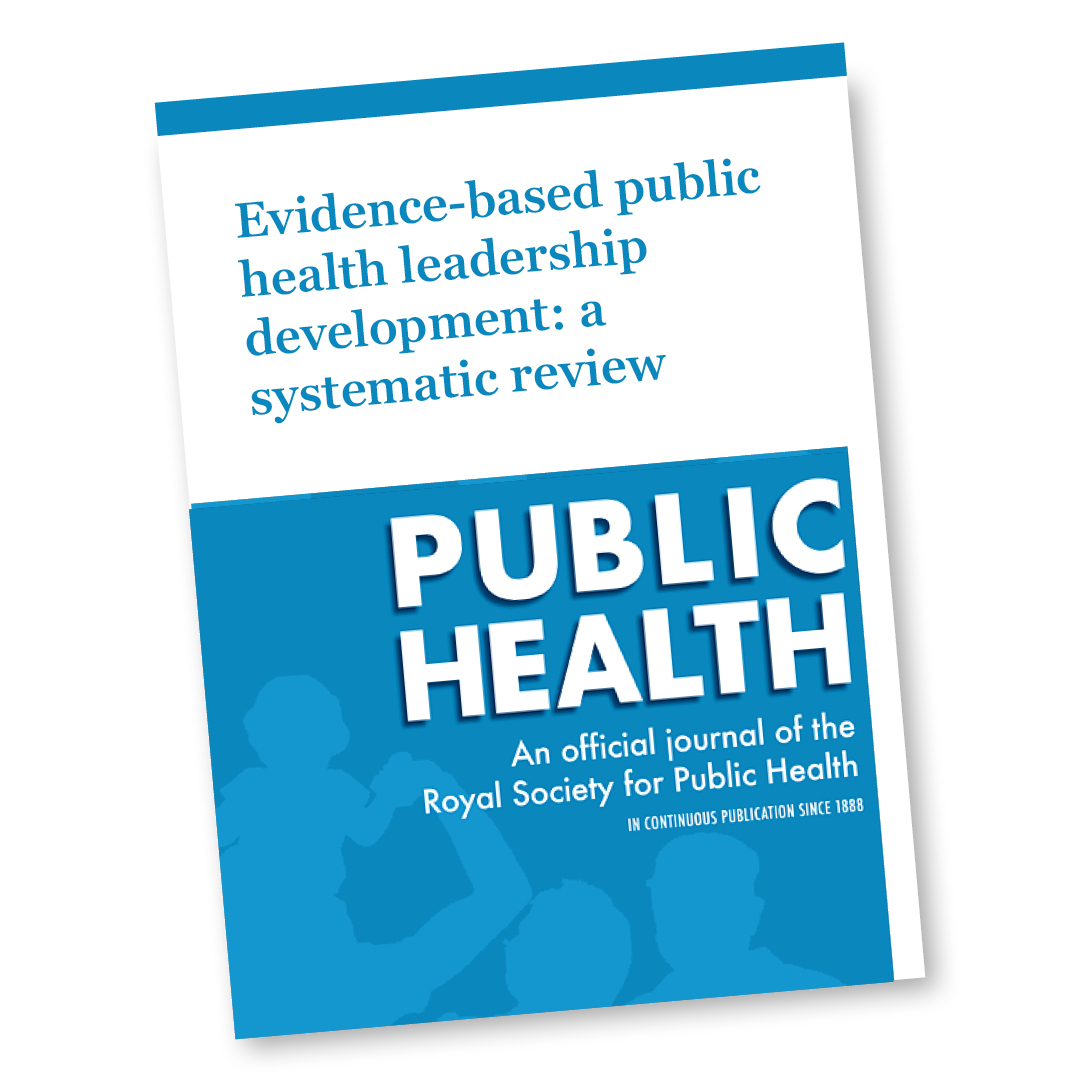

Public Health has recently published a systematic review which I have led, examining the evidence base for public health leadership development:
Day F., Snape V., Gardner D., Vinchenzo C., Dalili M.N., Baird S.G., Udu K., McManus J. (2026). Evidence-based public health leadership development: A systematic review and urgent call to include psychological theory. Public Health, Volume 253, 106178. https://doi.org/10.1016/j.puhe.2026.106178
A pre-publication soft copy is available here.
This paper asks a critical question:
Are we developing public health leaders and global health leaders with the same commitment to evidence that underpins public health practice itself?
Why This Public Health Leadership Review Matters
Public health leadership is central to navigating:
- Complex health inequalities
- Workforce pressures
- Digital transformation
- Political and geopolitical instability
- System-wide reform
Yet despite the scale of these challenges, there is little consensus about:
- The optimal structure of leadership development
- The most effective teaching and coaching methods
- The right timing across careers
- How to evaluate impact
- Whether interventions are grounded in psychological theory
In a discipline committed to evidence-based practice, this gap is striking.
What the Review Did
We conducted a systematic review using PRISMA guidelines to identify and synthesise empirical research on the effectiveness of public health leadership development interventions.
After de-duplication and screening, 20 papers were included for full data extraction.
The studies:
- Were published between 2007 and 2025
- Represented diverse international settings
- Included sample sizes ranging from 7 participants to over 1500 in national organisations
Interventions were synthesised across:
- Individual-level development
- Organisational-level interventions
- System-level and population health outcomes
The Key Finding: Where Is the Psychological Theory?
Only three studies explicitly referenced psychological theory as a foundation for their leadership development interventions.
Three.
In a field addressing behavioural change, systems complexity, workforce wellbeing, and adaptive leadership under pressure, the limited integration of psychological theory is concerning.
Without psychological underpinning, leadership development risks becoming:
- Competency checklists
- Short-term training events
- Generic programmes detached from context
- Interventions that measure satisfaction rather than transformation
Coaching is Effective for Public Health Leadership Development
The review suggests that effective public health leadership development is less about isolated courses and more about ecosystems.
These ecosystems combine:
- Formal training
- Coaching
- Team-based practices
- Supportive organisational cultures
- Structural reinforcement
- Attention to equity and digital accessibility
In other words, leadership development is not an event. It is a system.
Why Coaching Psychology Matters
Coaching Psychology — the science of workplace performance, behaviour change, and wellbeing — is well positioned to strengthen this evidence base.
Psychological theory provides:
- Models of adult development
- Insight into motivation and behaviour change
- Understanding of stress and burnout
- Tools for emotional regulation and resilience
- Frameworks for leading in complexity
- Methods for evaluating meaningful impact
If public health demands rigour in epidemiology and intervention science, it should demand the same rigour in developing its leaders.
An Urgent Call
The review describes the evidence base as disparate and underdeveloped. It calls for greater integration of psychological theory and more coherent evaluation of leadership development interventions.
A pre-publication soft copy is available here.
Public health faces unprecedented complexity — climate threats, widening inequalities, digital disruption, and geopolitical instability.
We cannot afford leadership development that is:
- Theoretically thin
- Structurally isolated
- Poorly evaluated
- Detached from wellbeing science
If we are serious about strengthening the public health workforce, we must ask:
- Is our leadership development grounded in psychological theory?
- Does it address performance and wellbeing?
- Is it evaluated with the same rigour as our public health interventions?
- Are we building short-term skills — or long-term leadership capability?
Public health is built on evidence. It is time to apply that same standard to how we develop those who lead it.
If you’re looking for medical leadership coaching, coaching for healthcare senior leaders and CEOs, public health, or global health leadership coaching underpinned by coaching psychology theory, get in touch!
Dr Fiona Day is individually accredited as a Chartered Coaching Psychologist with the British Psychological Society and by EMCC as a Master Practitioner Coach. She is a former system and Board-level medical & public health leader and occupational physician.
Book a Confidential Consultation today!
Fiona specialises in coaching medical and public health leaders, and trains health leaders in coaching skills at EMCC EQA Foundation Level. Get 3 hours of FREE CPD with Fiona’s ‘Health Career Success Programme’ here, and listen to her NEW podcast ‘Transformational Thinking for Health Leaders’ here.