
I was recently contacted regarding this request at my career clinic at the UK Faculty of Medical Leadership and Management Conference.
‘Any advice for strategies in dealing with ‘imposter syndrome’, and also with lack of confidence? I struggle with being overly self-critical and feel it sometimes affects my performance’
Here’s my response.
Thank you for asking this difficult question, it tells me a lot about your own values of courage and willingness to be vulnerable in service of your own wellbeing and performance.
There is a lot of ‘talk’ about ‘imposter syndrome’, a colloquially used term to describe feelings of inadequacy in the workplace. As a Chartered Coaching Psychologist specialising in evidence-based cognitive-behavioural approaches, this is a subject that medical leaders talk with me about on a daily basis. Indeed, my observation over the years is that the more senior a leader one is, the more one can be troubled by self-doubt.
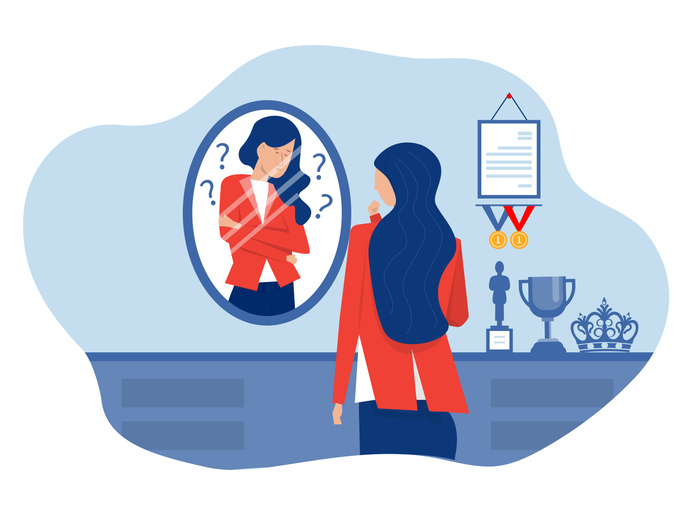
Before we dive into strategies, I think it’s helpful to pause and take a moment to understand what is meant by the term. Usually, ‘imposter syndrome’ relates to difficult thoughts (not being good enough, being found out), difficult feelings (fear, shame), and results in associated body sensations in high performance situations such as speaking in a higher risk social situation where one feels that one’s performance is being judged, and could be found lacking, or for some people it is more of a vague sense of unease such as ‘How did I get here, I’m just a kid in the playground in my own head!’. The ‘fight, flight, freeze, fawn’ threat system is often activated and this can result behaviours which can be unhelpful such as overcompensating to prove one’s worth, or being less vocal or present than one is capable of. The roots are in evolution, we needed to know our place in the tribe, not upset the people at the top, and make sure we didn’t end up at the bottom or worse, cast out onto the savannah on our own. It’s a form of social anxiety linked to ‘unrelenting standards’ and it can be very helpful – as well as being problematic. It’s also very normal, our brains are hardwired this way for a reason, and if we don’t have a certain amount of ‘healthy self doubt’ then we can make poor decisions and fail to take others’ perspectives into account.
So I suggest you start by thinking of ‘imposter syndrome’ as an evolutionary response to being in a group, and to consider it as serving a helpful function at times.
If you imagine a spectrum as follows:
No insight into Overly focused with
our impact on <———————————> worrying about our
other people impact on other people
See where you currently self-assess yourself as being on this spectrum. If you are at an extreme end of the spectrum, then consider a clinical assessment and or intervention.
If you are not at an extreme end of the spectrum, then you can learn to notice the thoughts, feelings, sensations, and behaviours which are unhelpful, and with self-compassion over time learn how to notice what is happening, ‘unhook’ from the unhelpful thoughts and feelings (cognitive defusion is the psychological term), and start to make conscious choices about your behaviour in line with your values. You have values of courage and willingness to be vulnerable already, these can give you a place to stand while you learn how to manage your mind in increasingly skilful ways.
As a former strategic leader, I would also say, the environment in which you work can exacerbate feelings of self-doubt. We need to take a systems perspective – you can learn the skills you need to manage your self-criticism, and there maybe changes which are needed in your workplace to make it a more supportive environment to bring out the best in you.
My recent journal article in BMJ leader describes the impact of coaching psychology on medical and public health leaders wellbeing.
Do keep in touch and let me know how you get on and whether you have any further questions.
This article was originally published by the Faculty of Medical Leadership & Management as a blog in June 2023.
Dr Fiona Day is a Chartered Coaching Psychologist accredited by the British Psychological Society, and by EMCC as a Master Practitioner Coach & Mentor. She has experience as a system and Board-level medical and public health leader. Fiona focuses on coaching medical and public health leaders, and also trains health leaders in coaching and mentoring skills at EMCC EQA Foundation Level. Get 3 hours of FREE CPD with Fiona’s ‘Health Career Success Programme’ here, and listen to her podcast ‘Transformational Thinking for Health Leaders’ here.