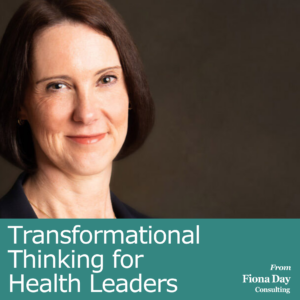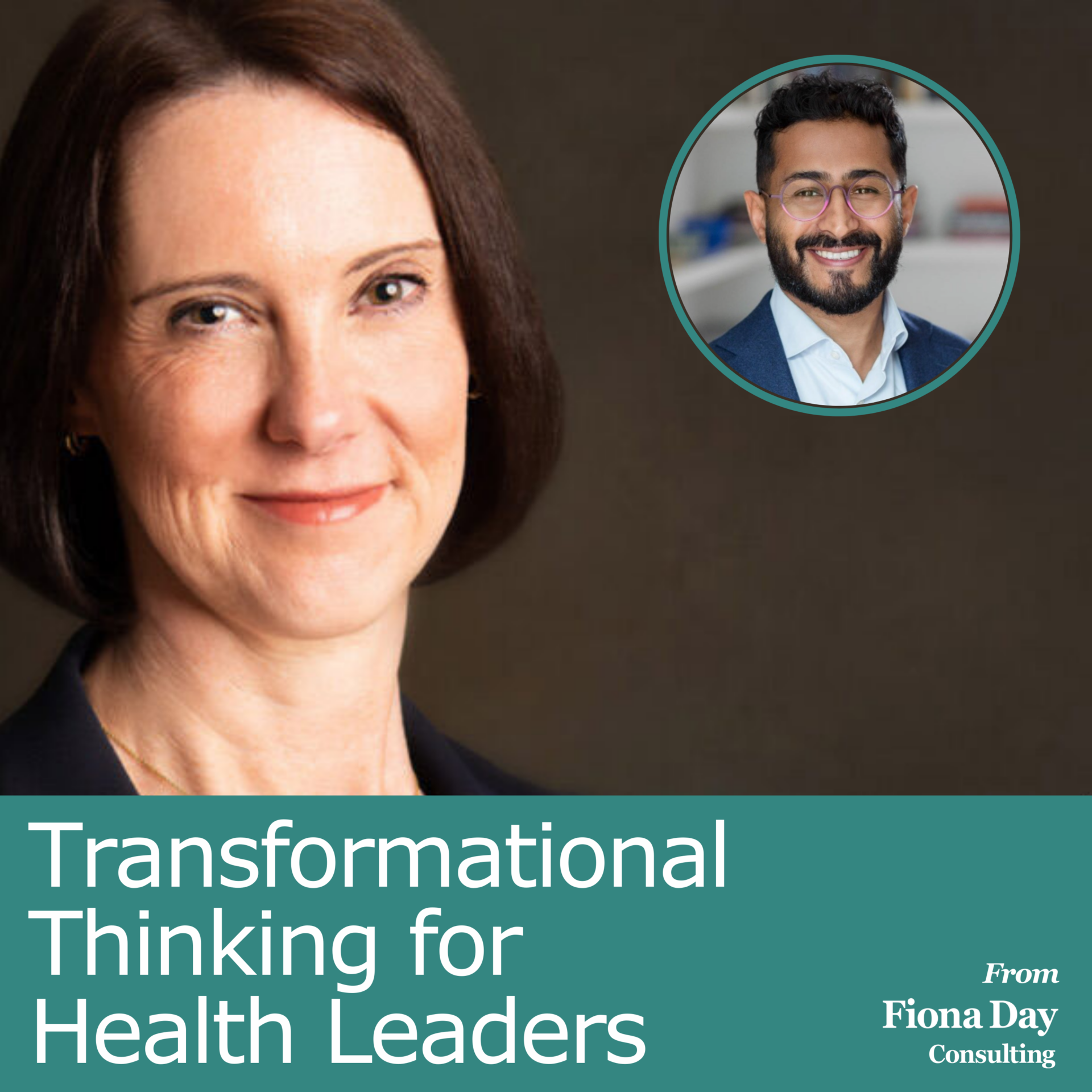

Health leadership is not just about expertise—it’s about vision, courage, and the ability to step into new spaces to drive meaningful change. In a recent episode of my podcast, Transformational Thinking for Health Leaders, I had the pleasure of speaking with Dr. Reza Jarral, a primary care doctor with a passion for democratizing well-being for underserved populations.
Reza’s journey is nothing short of inspiring. Trained as an NHS GP, he moved to New Zealand, where he has led multi-million-dollar healthcare initiatives, developed equity-focused telehealth services, and is now preparing for a Harkness Fellowship at the Commonwealth Fund in New York. His work sits at the intersection of health technology, behavioural science, and health equity, aiming to ensure that digital transformation benefits the people who need it most.
In this blog, I’ll share key insights from our conversation, exploring how Reza transitioned from frontline GP to global health leader, the lessons he’s learned along the way, and his vision for the future of healthcare.
From GP Training to Global Health: A Non-Linear Leadership Path
Reza’s leadership journey began not in a boardroom, but in deprived communities—from inner-city London to sub-Saharan Africa and the indigenous populations of New Zealand. His commitment to serving high-needs groups shaped his career, but as he shared, confidence wasn’t something that came naturally at first.
In fact, public speaking and communicating at scale were once major challenges for him. But through a growth mindset, he actively worked on these skills, ultimately becoming a clinical advocate at the national and global level—speaking on live radio, engaging with politicians, and leading policy discussions.
One of the most valuable takeaways from our conversation was this:
Leadership isn’t about being born confident—it’s about building confidence through action.
For anyone doubting their ability to lead, Reza’s story is proof that leadership is learned, not inherited.
Finding Purpose: The Power of Ikigai
Moving to New Zealand was a major life transition—one that initially left Reza feeling isolated from his professional networks. But it also led to a pivotal moment of self-reflection.
He turned to the Japanese concept of Ikigai, which helps individuals align their passions, skills, societal needs, and financial sustainability.
For Reza, the answer was clear:
✅ Passion: He loved technology and had built computers and games as a child.
✅ Skill: He was a trained GP with first-hand experience of patient needs.
✅ Societal Need: Health technology was growing, but it wasn’t always equitable.
✅ Viability: Digital health was a rapidly expanding industry with the potential for sustainable impact.
This led him to pivot into digital health leadership—ensuring that telehealth and AI-driven healthcare solutions were designed with health equity in mind, rather than widening the digital divide.
For leaders at a career crossroads, asking yourself: “Where does my passion meet the world’s needs?” can provide clarity on your next steps.
Driving Health Equity at Scale: Leadership at ProCare and Care HQ
Since moving into health technology, Reza has held several high-impact roles in New Zealand’s largest primary care organisations.
At ProCare, he led health equity and strategic development, overseeing primary care services for 850,000 people, including the highest-enrolled population of indigenous Māori and Pacific Islander communities. His work involved:
- Collaborative data-sharing to improve vaccine uptake.
- House-to-house vaccination initiatives during COVID-19.
- Global research partnerships with WHO and the Global Vaccine Data Network to combat misinformation.
At Care HQ, he played a key role in scaling a social impact-focused telehealth platform, ensuring that telemedicine reached the most underserved populations. His work resulted in:
- A 16x increase in telehealth adoption among Māori, Pacific Islanders, and low-income groups.
- Award-winning digital transformation initiatives.
- 120,000+ telehealth consultations delivered since launch.
Reza’s approach to digital health is a masterclass in ethical innovation—ensuring that technological advancements close gaps rather than create them.
Leadership as Service: Reza’s North Star
At the heart of Reza’s work is a deep commitment to service—a value he attributes to his family’s journey.
His grandparents, born in small villages in Punjab, faced significant hardship. Their resilience paved the way for his parents’ success, which in turn enabled Reza to pursue medicine in the UK.
“The pathway to leadership is through service.” — Samoan Proverb
This guiding philosophy informs his leadership style:
- Serving communities by ensuring healthcare innovation reaches those who need it most.
- Serving his teams by removing barriers and enabling them to thrive.
- Serving the future of healthcare by advocating for ethical digital health policies.
His story is a reminder that leadership isn’t about power—it’s about using your position to uplift others.
The Next Chapter: Digital Health and Behavioural Science at Stanford and the Harkness Fellowship
In 2025, Reza embarks on a year of groundbreaking research in the United States. His focus? The intersection of:
- Digital health (wearables, AI, mobile health apps).
- Behavioural science (nudge theory, habit formation).
- Health equity (ensuring these innovations benefit all populations).
Reza believes that healthcare is decades behind industries like e-commerce and social media in using behavioural design to influence human behaviour. While Amazon, Netflix, and YouTube use data-driven nudges to shape consumer choices, healthcare still relies on one-size-fits-all approaches to behaviour change.
His goal is to apply the same precision to preventive healthcare, helping people make better decisions about diet, exercise, smoking, and mental well-being.
This research will be supported by the prestigious Harkness Fellowship, awarded by the Commonwealth Fund to emerging global health leaders.
Reflecting on the application process, Reza shared a powerful insight:
“Four years ago, I didn’t think I was ‘qualified’ enough to apply. But then I asked myself—if not me, then who?”
His success is a reminder that sometimes, the only thing standing between us and opportunity is our own self-doubt.
Key Takeaways for Health Leaders
- Leadership is learned, not inherited.
- Confidence grows through action, not waiting until you feel “ready.”
- Find your Ikigai—where passion meets purpose.
- Align what you love, what you’re good at, what the world needs, and what is sustainable.
- Digital health must prioritise equity.
- Innovation should reduce, not widen, healthcare disparities.
- Leadership is service.
- The best leaders remove barriers and enable others to succeed.
- Step up for opportunities—before you feel “ready.”
- If not you, then who?
Reflective Questions for Health Leaders
- What personal challenges have shaped your leadership journey?
- How can you ensure that digital innovations in your field promote equity?
- What barriers (internal or external) have held you back from stepping into leadership roles?
- What legacy do you want to leave through your work?
- What’s one bold step you could take today toward your next leadership goal?
To hear more from Reza, listen to the full podcast episode. And if you’re looking to advance your leadership journey, visit www.fionadayconsulting.co.uk for free CPD resources designed for medical and public health leaders.
Here’s to leading with purpose, courage, and vision!
Dr Fiona Day is the world’s only Leadership Coach with advanced coaching psychology, medical and public health qualifications (MBChB, FFPH, BPS Chartered Psychologist in Coaching Psychology, EMCC Master Practitioner Coach & Mentor) and is in a unique position to help you and your teams to flourish. Fiona specialises in coaching medical and public health leaders, is a coach Supervisor, and an EQA Foundation Award Holder. Get 3 hours of FREE CPD with Fiona’s Health Career Success Programme here. Book a free confidential 30 minute Consultation with Fiona here. Subscribe and listen to her Podcast ‘Transformational Thinking for Health Leaders’ here.